

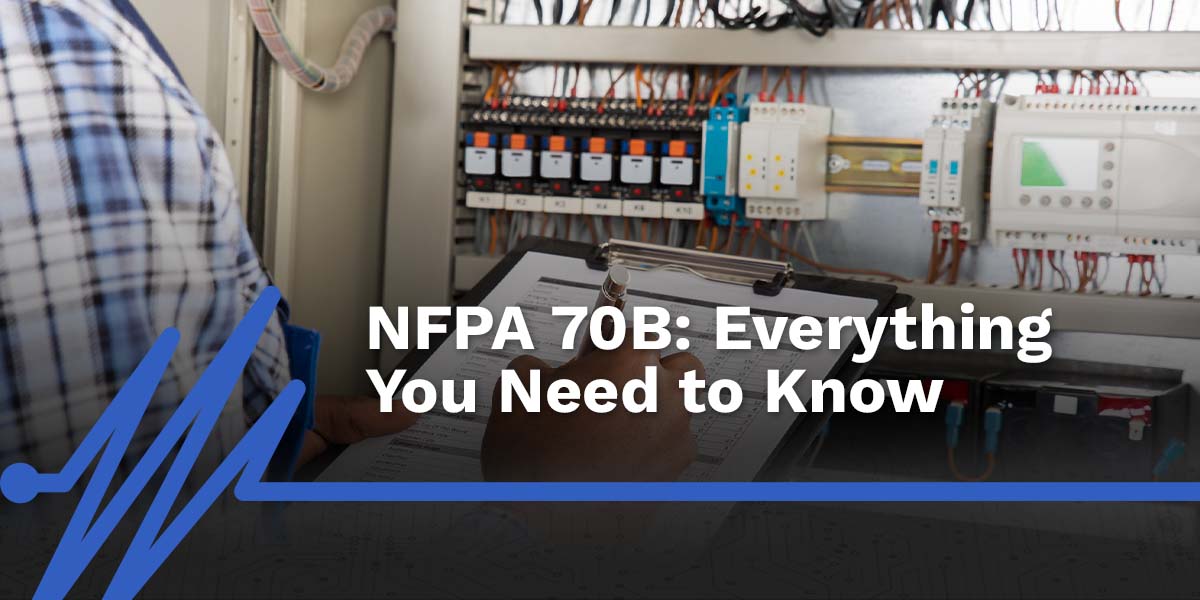
The National Fire Protection Agency (NFPA) guides many aspects of workplace electrical safety, including NFPA 70, or the National Electrical Code (NEC). The NEC outlines a wide range of benchmarks for safe behaviors and practices around electricity, and the January 2023 update created new requirements for electrical equipment maintenance in many commercial and industrial environments.
Implementing NFPA 70B’s requirements calls for comprehensive planning and training. As NFPA 70B closely relates to standards from the Occupational Safety and Health Administration (OSHA), any organization hoping to maintain OSHA compliance must understand these requirements.
The core shift: As of the 2023 edition, NFPA 70B has transitioned from a “Recommended Practice” to a Mandatory Standard. The language has shifted from “should” (optional) to “shall” (enforceable).
The new mandate: Every industrial facility shall establish and implement a written electrical maintenance program (EMP). Maintenance intervals are no longer arbitrary. Instead, they must be determined by an Equipment Condition Assessment (ECA) that evaluates the physical health, criticality and environment of your assets.
NFPA 70B is a set of standards outlined in the NEC that addresses electrical equipment maintenance, including inspections, testing, cleaning, repairs and safety procedures. Before 2023, NFPA 70B contained recommendations, but the update codified these suggestions as enforceable standards.
Different entities, like OSHA and other government organizations, often require adherence to NFPA standards, and the updates to NFPA 70B are now required. NFPA 70B mandates now include:
The essential components of a mandatory Electrical Maintenance Program (EMP).
Safe work practices and procedures for conducting maintenance tasks.
Required inspection and testing intervals for critical assets.
Step-by-step guidelines for launching your facility’s EMP.
NFPA 70B goes hand in hand with NFPA 70E, which covers electrical safety in the workplace. While 70B outlines maintenance practices that promote electrical safety, 70E helps ensure that employees perform those maintenance practices safely.
Other related standards might include NFPA 99 (Health Care Facilities Code) and NFPA 110 (Standard for Emergency and Standby Power Systems).
The contents of NFPA 70B span several areas of electrical maintenance, including an electrical safety program and the EMP. While the standard provides requirements, manufacturer guidelines generally take precedence, so you might defer to them if available. Here are a few major components of NFPA 70B:
An EMP is a detailed maintenance plan for electrical equipment that can support continued safety and performance. The NFPA 70B requirements outline a thorough EMP that:
If you are unsure where your facility stands, start with this foundational audit. A compliant EMP must include:
Current single-line diagrams: Have your electrical drawings been updated within the last 5 years? This is mandatory for accurate short-circuit studies.
Written EMP document: Do you have a physical or digital document that explicitly outlines your maintenance strategy?
Condition 3 remediation: Have all of your assets that are identified as “Condition 3” (urgent) been scheduled for immediate service?
Accessible records: Are your test reports and service logs accessible to the AHJ upon request?
If you answered “No” to any of the above, contact IEC today to schedule an initial EMP audit.
The updated standard added more detail and specificity to the term “condition of maintenance.” NFPA 70B requires equipment condition assessments (ECAs) to establish a piece of equipment’s condition across three dimensions: its physical condition, criticality and operating environment. A piece of equipment can fall under Condition 1, Condition 2 or Condition 3 for each of these dimensions, with lower numbers indicating better conditions.
The highest-rated condition determines the frequency of maintenance for the equipment. If a piece of equipment receives Condition 1 for physical condition and operating environment but Condition 2 for criticality, you would need to follow the maintenance intervals for Condition 2.
Under the new standard, “one size fits all” maintenance schedules are noncompliant. You must assign a condition rating to every asset — from switchgear to battery systems — to determine its required service frequency. Use the table below as a general guide for standard equipment types:
| Equipment Condition | Description | Required Interval (Typ.) |
|---|---|---|
| Condition 1 | “Like New” condition. Clean, dry, tight enclosure. No active alarms. | 60 Months (5 Years) |
| Condition 2 | Serviceable but showing minor wear, deviations in past tests or missing records. | 36 Months (3 Years) |
| Condition 3 | Urgent issues, active moisture/dirt or unaddressed alarms. | 12 Months (1 Year) |
Note: Equipment categorized as “Unserviceable” requires immediate corrective action.
You could also give a piece of equipment an unserviceable or nonconforming designation. Unserviceable equipment creates an imminent risk of injury or negative health, while nonconforming equipment doesn’t fall into any of the other condition categories. Either of these designations must receive immediate corrective action.
While each product has its own list of required maintenance tasks, most need:
Compliance is a shared responsibility, but the new standard clarifies specific duties. Understanding these roles ensures your facility avoids liability gaps.
The owner (facility manager): Ultimately liable for the existence and execution of the EMP. You shall ensure the program is documented and funded.
The qualified person (IEC technician): Responsible for performing the actual inspections, testing and servicing. They must be trained to recognize the hazards associated with the specific equipment they are auditing.
The authority having jurisdiction (AHJ): The entity (fire marshal, building inspector, or OSHA representative) that enforces the standard. They now have the authority to cite facilities that lack a written EMP.
NFPA 70B requires that any personnel carrying out the EMP have proper qualifications for the task at hand. Qualified persons have demonstrated their knowledge and skills surrounding electrical equipment and have completed relevant safety training. Some aspects they should understand include:
You may need to retrain employees if:
Remember, documenting adherence to these training requirements is also important for compliance with NFPA 70B.
While OSHA doesn’t directly enforce NFPA standards, it can use the standards as evidence of a national industry consensus for safe practices. We’ve explored this situation in a blog post on OSHA citations from NFPA 70E, but in short, noncompliance with NFPA 70B can result in an OSHA violation.
Say a company violates OSHA’s standards by allowing untrained personnel to work with electrical hazards. OSHA could issue a citation for an unsafe work environment and point to NFPA 70B as evidence of what training programs and skills the workers should have in different scenarios.
NFPA 70B’s impact on OSHA citations is just one of the reasons compliance is so valuable. Between increasing penalties for violations, corrective action requirements, litigation risks and reputational damage, OSHA compliance is crucial for protecting the bottom line.
Beyond compliance concerns, NFPA 70B’s preventive maintenance guidelines can offer valuable benefits in other areas:
To enjoy these benefits, you’ll need two types of electrical training that support the requirements of NFPA 70B. The first type addresses electrical compliance by helping you identify needs and develop programs that meet the standard’s requirements. The second type of training ensures workers perform tasks correctly and stay safe during the process. Hands-on electrical safety training services can help your team build their skills toward becoming qualified personnel.
Shifting NFPA 70B to a standard created new compliance considerations for many industrial and commercial organizations. If you don’t already have a thorough EMP or appropriate personnel training, prioritize your compliance with NFPA 70B immediately.
For businesses in California and parts of Nevada, Industrial Electrical Company can help. We offer robust training services designed to meet NFPA 70B and other relevant standards, including those from OSHA. Our NFPA 70B training courses cover compliance, safety and maintenance fundamentals. As you acquire new equipment or hire new staff members, we’re here to offer continued training
Reach out to us today to set up training services and work toward full compliance with NFPA 70B.

Our motor shop is located right in the Central Valley and can complete any job from total welding services to custom modifications. To learn more about our services, classes and products, contact us online today.